
Choosing an analytics deployment model: SaaS, single-tenant or self-hosted?
Most teams evaluate product analytics on features, integrations and pricing. Few evaluate the deployment model underneath. Understanding the architectural trade-offs early prevents an expensive migration later.

Analytics used to be a dashboard. It is now infrastructure: experimentation pipelines, engagement triggers, revenue reporting and, increasingly, the context your AI features run on all depend on it. As soon as a system becomes infrastructure, two things change. Performance expectations go up, and compliance requirements arrive with them. That makes the deployment model of your analytics platform a strategic decision, not an implementation detail.
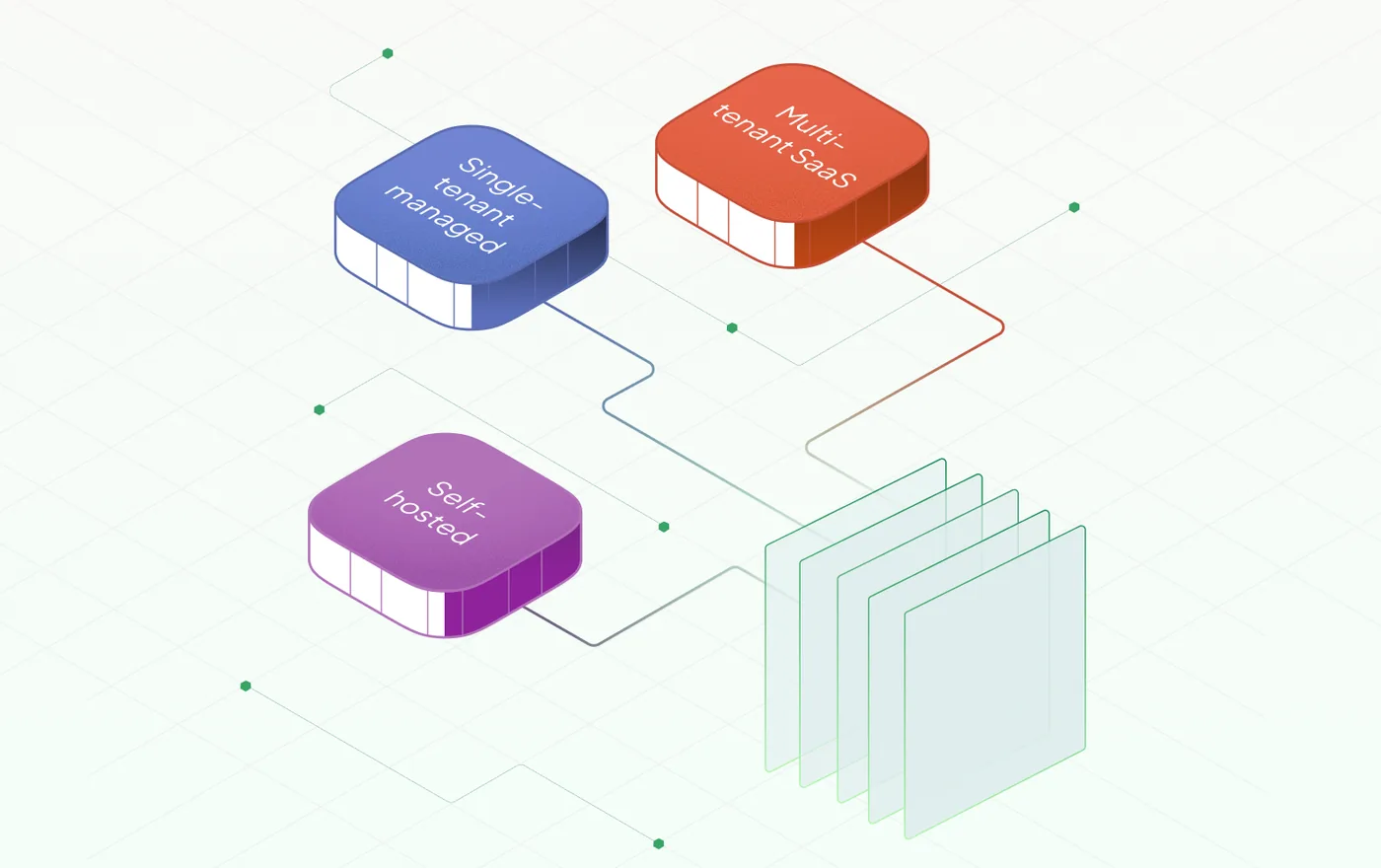
There are three models in modern product analytics. Each optimizes for something different, and each has a point at which its trade-offs start to show.
- Multi-tenant SaaS
- Single-tenant managed
- Self-hosted
1. Multi-tenant SaaS: simplicity at scale
In a multi-tenant SaaS, many customers share the same compute clusters and storage. The vendor balances query workloads across tenants and scales the shared infrastructure as a whole. It became the dominant model for good reasons. Onboarding takes minutes, there is no operational overhead, scaling is automatic and the barrier to entry is low.
The trade-offs emerge with volume. Shared infrastructure forces the vendor to manage workloads: query prioritization, resource throttling, tier-based limits, internal queueing. Your performance becomes a function of vendor-level policy as much as of your own workload. The model optimizes for the vendor’s efficiency and operational simplicity, and gives up strict workload isolation to get there.
2. Single-tenant managed: isolation without the operational burden
In a single-tenant managed model, every customer gets a dedicated analytics instance with isolated compute and storage, while the vendor still runs the infrastructure. Architecturally this changes three things. Cross-tenant resource contention disappears, resource allocation becomes deterministic, and scaling happens per instance instead of per cluster policy.
It fits growth-stage companies that need predictable performance, operate in security-conscious industries, or want infrastructure isolation without owning DevOps for it. The optimization target shifts from vendor efficiency to customer isolation.
3. Self-hosted: maximum control
Self-hosted analytics runs entirely inside the customer’s infrastructure. The customer controls compute, storage, scaling, security policy, networking and customization. Enterprises choose it when regulation demands full data control, when internal policy prohibits shared infrastructure, when custom security or network configurations are required, or when long-term infrastructure standardization is a priority.
The trade-off is equally clear. Maximum control means full operational responsibility.
A framework for comparing the three
Four dimensions decide most evaluations. The tables below put the models side by side.
Infrastructure isolation
| Multi-tenant SaaS | Single-tenant managed | Self-hosted | |
|---|---|---|---|
| Compute | Shared | Dedicated | Fully controlled |
| Storage | Shared clusters | Isolated | Fully controlled |
| Cross-tenant contention | Possible | Eliminated | Eliminated |
Performance predictability
| Multi-tenant SaaS | Single-tenant managed | Self-hosted | |
|---|---|---|---|
| Workload isolation | Policy-based | Instance-based | Fully controlled |
| Resource guarantees | Tier-dependent | Provisioned per instance | Infrastructure-dependent |
| Deterministic scaling | Moderate | High | Very high |
Operational responsibility
| Multi-tenant SaaS | Single-tenant managed | Self-hosted | |
|---|---|---|---|
| Infrastructure management | Vendor | Vendor | Customer |
| Upgrades and maintenance | Vendor | Vendor | Customer |
| DevOps overhead | None | None | Required |
Compliance and data control
| Multi-tenant SaaS | Single-tenant managed | Self-hosted | |
|---|---|---|---|
| Data residency | Limited to vendor regions | Configurable | Fully configurable |
| Security customization | Limited | Moderate | Full |
| Audit isolation | Shared model | Isolated | Fully isolated |
When each model makes sense
Multi-tenant SaaS is the right default for early-stage startups, small teams without DevOps capacity, and organizations that value speed over isolation.
Single-tenant managed fits when data volume is growing fast, when performance predictability has become a requirement, when security reviews are getting stricter, and when the team wants isolation without running the platform themselves.
Self-hosted is appropriate when regulation mandates full control, when enterprise customers demand strict isolation, when infrastructure standardization is strategic, and when internal DevOps maturity is high.
Why this decision comes earlier than you think
Analytics platforms are rarely migrated casually. Once a system is wired into product workflows, dashboards, experimentation pipelines and reporting, switching it is expensive and disruptive. The deployment decision should therefore be made against a two- to three-year horizon: expected data growth, expanding regulatory exposure, plans to sell to enterprise customers, and the increasing internal use of behavioral data.
The bigger picture
SaaS optimizes for simplicity. Single-tenant optimizes for isolation without operational burden. Self-hosted optimizes for full control.
Analytics has grown from a dashboarding tool into operational infrastructure. Platforms that support more than one deployment model let an organization evolve its infrastructure as requirements change, without changing tools, retraining teams or rebuilding integrations. That is the case for choosing the model deliberately now, rather than discovering its limits later.